Wednesday, February 27, 2013

Sermon for February 24, 2013 / Lent II

Where is God When I’m Angry?
February 24, 2013 / Lent II
At that time some Pharisees said to him, “Get away from here if you want to live! Herod Antipas wants to kill you!” Jesus replied, “Go tell that fox that I will keep on casting out demons and healing people today and tomorrow; and the third day I will accomplish my purpose. Yes, today, tomorrow, and the next day I must proceed on my way. For it wouldn’t do for a prophet of God to be killed except in Jerusalem! O Jerusalem, Jerusalem, the city that kills the prophets and stones God’s messengers! How often I have wanted to gather your children together as a hen protects her chicks beneath her wings, but you wouldn’t let me. And now, look, your house is abandoned. And you will never see me again until you say, ‘Blessings on the one who comes in the name of the Lord! Luke 13:31-35
Every once in a while, we meet someone who is REALLY angry. I remember cutting someone off in traffic when I lived in Boston. If you’ve ever driven in Boston, you know that cutting people off and being cut off is a matter of survival . . . and enjoyment! But this was a close call, even by Boston standards. The driver not only laid on his horn in anger, he followed me to my destination. When I parked, he ran out of his car while it was still rolling to a stop, approached my humble, maroon Ford Taurus station wagon and began pounding on the roof of the car, swearing and shouting. He was out of control – telling me to come out of the car and apologize. There was no way I was getting out of my car. I was afraid of his anger.

Sometimes I hear people talk about feeling angry toward God. And sometimes they feel guilty about it. Take this letter for instance. It was written to a newspaper columnist:

At an early age, my mother was taken from me and my family due to an illness. It was a terrible blow for all of us to take. My biggest struggle then and now is my anger. I acknowledge the existence of a higher power but find it hard to believe in God. I'm angry with [God] for taking my mother from me. It seems as though God is made out to be our savior, our forgiver and our friend. Why would [God] tear my family life asunder by taking her from us? I've moved away from the Lord as a result, angry that [God] robbed such a powerful figure from my life. How can I cope with and heal my anger?

Death not only cost this man a mother. That alone is hard enough. He also feels alienated from God. His sense of how and why he belongs in this world has shifted. The one whom he intimately called “God” is now a source of abandonment. I wonder if that’s how the psalmist felt when writing the words of Psalm 27. Addressing God, the psalmist writes, “Do not turn your back on me. Do not reject your servant in anger. You have always been my helper. Don’t leave me now; don’t abandon me, O God of my salvation!” We hear this desperate tone in many of the psalms. Listen to the opening words of Psalm 13:
    Long enough, God— you've ignored me long enough.
    I've looked at the back of your head long enough.
    Long enough I've carried this ton of trouble,
    lived with a stomach full of pain.
    Long enough my arrogant enemies
    have looked down their noses at me.
Let’s be honest. Sometimes we get angry. Sometimes we get angry when we feel like we have no control over our lives. It may be a failed relationship. Or the death of a loved one. Or growing worry over an unending health crisis. Or financial concerns. Sometimes, we get angry at God. And sometimes we feel guilty. The problem is some of us have been told that it’s inappropriate to get angry at God. We worry that God's feelings will be hurt. Or worse yet, God will return our anger. God will be like that angry man in Boston, pounding on the roof of my Ford Taurus Wagon with frothing, unbridled rage. Many of us were raised to believe that God is much better at being angry than we can ever be. There is an old saying: Never try to teach a pig to sing; it wastes your time and it annoys the pig. Some people think the same reasoning applies to our relationship with God. Never get angry at God. It wastes your time and annoys God. And you do not want to be on the receiving end of God’s anger. Remember good old Jonathan Edward’s sermon, Sinners in the hands of an Angry God? Edwards imagines people dangling from the hand of God over the pit of hell. He writes, “they have deserved the fiery pit, and are already sentenced to it; and God is dreadfully provoked, his anger is as great towards them . . .” No one wants to get that God angry!

I no longer listen for God in those texts. I say go ahead and let yourself feel angry. Anger is a sign that something is wrong. And it’s OK to let God know about it. God already knows that we are angry, and God knows WHY we are angry. God knows our feelings of helplessness, fear, confusion, and disappointment that lead to our anger. Sometimes we feel angry because we are powerless. God knows our powerlessness. Sometimes we get angry because we are hurt. God understands pain. God might even share our anger!

Consider the scene we read from Luke’s Gospel. Jesus has some allies in the camp of the Pharisees. They warn Jesus to run, because Herod is on the lookout from him. Jesus would be wise to follow their advice -- Herod is worth running from. Herod is a menace and an iconic bully. Herod is not so much a despot as a manipulator, which is a bully’s prime talent.  He achieves his goals through economic oppression.  Money, taxation, and opulence are among his weapons. Herod’s works are huge, elaborate, and expensive. In contrast, Jesus’ works are disarmingly simple, freely given, and liberating.  Jesus says Herod is like a fox, and he is like a mother hen. Herod wants to rule with slyness and fear. Jesus wants to draw and protect the people of Jerusalem as a hen gathers her brood under her wings.

I hear some anger in Jesus’ words, too. To me, Jesus sounds angry at a ruler who is, by all accounts, a sociopath. Jesus is angry at a political system that where leaders use poverty as a tool of domination; where the rich become richer as they devour resources that could be used for the common good. Jesus is angry at a city that closes its ears to the truth of God’s reign, kills its prophets and punishes God’s messengers. Even thinking about it stirs anger within my own heart. I wonder if Jesus feels the same way.

Remember, Luke is collecting and compiling his stories long after Jesus has died and risen. Luke and his congregation are still living in a broken world. He wants his readers, his congregation, to understand something through this event. He wants them know that when they look at the condition of the world around them, there is plenty to be angry about. Luke sees idolatry, persecution of prophets, injustice, inequality, exploitation, poverty, scarcity, violence, and death. He sees people who are beat up, worn down, and angry. But that’s not the end of the story. Anger is an invitation. It’s an invitation to experience their violent, alienating world as it really is. It’s an invitation to make a change. Luke’s audience has an opportunity to join a movement that can free them from the entwining values of their broken world. In Christ, they can weave new values into society; values like love, peace, justice, equality, mutuality, solidarity and life.

Luke is preaching to our congregation, too. We can look around us and get angry at the broken world around us. And that is OK. The anger is an invitation to make the world better. Our anger can lead us to the realization that cultures built on self-centeredness, racism, exploitation, manipulation, sexism, homophobia, ultra-nationalism and threat of violence can expect those very things to lead to the eventual breakdown of that culture. Luke offers a vision of the church, our church, as a prophetic community that engages in ministry on behalf of the aims of God.

Listen to this quote about prophetic anger:
"I had no epiphany, no singular revelation, no moment of truth . . . but a steady accumulation of a thousand slights, a thousand indignities, a thousand unremembered moments, produced in me anger, a rebelliousness, a desire to fight the system that imprisoned my people."
Nelson Mandela wrote those words in his book Long Walk to Freedom. Mandela was angry at the injustice of apartheid. He was not remorseful or ashamed of this anger — it was actually a source of blessing. Anger moved people enough to stand up, to fight for freedom, and to change the unjust system of oppression that was governing South Africa. What an incredible gift anger can be -- to be upset and aware. Anger can be a great motivator to help us seek justice and change in the world.

Our feelings do not surprise God. Instead of letting your anger block God, use your anger to let God in. Tell God how you are feeling. Let God know your deepest, darkest fears and concerns. Invite God to know your sorrows and count your tears. You may never get all the answers, but you may get something else. You may get comfort instead of answers. You may get motivated to change your part of the world.

I think it’s OK to be angry at God, but it’s not OK to stay angry. That only hurts you. Ongoing anger doesn’t affect God. But it changes you. Ongoing anger changes the way you perceive reality. Ongoing anger harms your relationships. Over time, these feelings keep us from experiencing the liberating, transforming, renewing, glorious new life that God wants us to have. Anger is a holy, if difficult intimacy. Whatever causes you to feel pain is now part of your spiritual journey. It calls for strength, and honesty, and the steadfast assurance that God is for us.

“Anybody can become angry — that is easy,” said Aristotle, “But to be angry with the right person, and to the right degree, and at the right time, and for the right purpose, and in the right way — that is not within everybody's power and is not easy.” A minister named Dale Turner reminds us of this one certainty in life: “Were anger and moral indignation to die out of the world, society would swiftly rot to extinction. It is possible to be good — and at the same time — be angry. God both wills and encourages it.” There are still things that still make God angry in this world. There are still things in this world that make God weep. Injustice, aching poverty, discrimination and systematic oppression. God is still angry, and we should be too. We can commit to doing things about them. The important thing is that we be angry about the right things, and express it in appropriate ways. May our anger be directed to constructive ends so that God’s love may grow, and all people may know the God of compassion, justice and peace.

Sources:
http://www.lvrj.com/blogs/kalas/It_takes_great_faith_to_be_angry_with_God.html
http://www.whosoever.org/v5i3/adam.html
http://www.iclnet.org/pub/resources/text/history/spurgeon/web/edwards.sinners.html
http://protestantism.suite101.com/article.cfm/prayers-for-anger
http://biteintheapple.com/that-fox/
http://www.goodpreacher.com/shareit/readreviews.php?cat=47

Monday, February 11, 2013

Sermon for February 10, 2013 / Transfiguration Day

Healers or Haters?
Celebrating the National Preach-in on the Environment

Today, I want us to consider this proposal: The earth is God’s beloved, and we need to listen to her. What might it mean to be attentive to the messages God wants to send us through the creation around us.  The earth is God’s beloved, and we need to listen to her.  Think about his as we consider out Gospel text for today – Luke’s version of the transfiguration of Christ. Today we are going to use this story as metaphor that can illuminate us about the possibility of a renewed, radiant, transfigured planet.
Now about eight days after these sayings Jesus took with him Peter and John and James, and went up on the mountain to pray. And while he was praying, the appearance of his face changed, and his clothes became dazzling white. Suddenly they saw two men, Moses and Elijah, talking to him. They appeared in glory and were speaking of his departure, which he was about to accomplish at Jerusalem. Now Peter and his companions were weighed down with sleep; but since they had stayed awake, they saw his glory and the two men who stood with him. Just as they were leaving him, Peter said to Jesus, ‘Master, it is good for us to be here; let us make three dwellings, one for you, one for Moses, and one for Elijah’—not knowing what he said. While he was saying this, a cloud came and overshadowed them; and they were terrified as they entered the cloud. Then from the cloud came a voice that said, ‘This is my Son, my Chosen; listen to him!’ When the voice had spoken, Jesus was found alone. And they kept silent and in those days told no one any of the things they had seen.  Luke 9:28–36

I recently read these words from American libertarian and political commentator Lew Rockwell: “I am a sinner but unrepentant. You see, I don't practice environmentalism, and I don't believe in it. I don't recycle and I don't conserve-except when it pays to do so. I like clean air -- really clean air, like the kind an air conditioner makes. I like the bug-free indoors. I like development, as in buildings, concrete, capitalism, prosperity. I don't like swamps . . . or jungles ("rainforests"). I see all animals except dogs and cats as likely disease carriers, unless they're in a zoo. When PBS runs a special on animal intelligence, I am unmoved. I'm glad for the dolphins that they can squeak. I'm happy for the ape that he can sign for his food. How charming for the bees that they organize themselves so well for work. But that doesn't give them rights over me. Their only real value comes from what they can do for man . . . Not being a do-it-myselfer, my favorite section of the hardware store features bug killers, weed killers, varmint traps, and poisons of all sorts. These killer potions represent high civilization and capitalism. The bags are decorated with menacing pictures of ants, roaches, tweezer-nosed bugs, and other undesirable things, to remind us that the purpose of these products is to snuff out bug life so it won't menace the only kind of life that has a soul and thus the only kind of life that matters: man.”

Rockwell’s perspective has a strong foundation in Western culture and theology – the idea that the world was created for human advancement and enjoyment. The idea comes from the Greek philosopher Plato. Plato regarded the earth as temporary and worthless -- a mere shadow of the ultimate reality. Plato proposed a second world outside space and time – a non-material world of pure thought and ultimate truth. He was the first one to say that a soul could exist independent of one’s body. The end result was a culture skewed towards the belief that things are not always as they appear. As a result, thinkers tended to view the world as made up of the profane, and the sacred. The profane was changing, shifting, unreliable. The sacred was unchanging ultimate reality. Plato’s ideas had some powerful effects on religious thinking. Dualism influenced the founders of the early church, from Paul to Augustine -- people who lived in the epicenter of the Greco-Roman world. Even now, Western Christians have been conditioned to divide every subject into two: left/right, good/bad, evangelical/liberal, healer/hater, and so on. Dualities multiply and abound. Out of this comes the traditional Christian teaching that the material world is of lesser importance than the ultimate reality of an orderly, dispassionate unchanging God.

Lew Rockwell’s comments are the ultimate expression of dualism. We are not connected to the earth. There is no true sense of ecology – literally “the study of our dwelling place.” For Rockwell expresses what’s in the minds of many people: humans are the crowning glory of the planet, separate from it, and able to use and control its resources to advance human achievement.

I think we need to question the assumptions of our worldview. Is God really an orderly, dispassionate deity? Luke's gospel describes how Jesus called twelve ordinary people to be his closest confidants. Jesus invested them with power and authority to drive out demons and to enlighten the darkness; to cure diseases; to preach the subversive love of God and to heal the sick. "So they set out and went from village to village," writes Luke, "preaching the gospel and healing people everywhere.” Jesus invites followers to be healers and not haters. Healing love is the mark of a disciple. Jesus invites followers to bring the outsider inside. To include the excluded. He tells followers to befriend the broken, heal the hurting, and embrace the unfamiliar. Jesus calls followers to care and to cure, not to condemn. It was a tall order. The first disciples stumbled and bumbled, failed and floundered. They couldn't heal. They didn't understand.

We see it on the Mount of Transfiguration. When faced with the reality of who Jesus really is, the disciples cower in terror. Their fear is an indication to us, the readers, that something has gone wrong. The disciples consistently fail to see who Jesus is, what he has come to do, and what he asks them to do. They are so frightened, they become ineffective disciples. Fear clouds their ability to listen. And that’s all they have to do. The voice from heaven has a command for everyone on the mountaintop: Listen to my beloved. Listen! It’s interesting to me two prophets from history are there. Moses is the greatest prophet in Jewish history. Moses is the law-giver and prophet of promise. And Elijah, who fights against a wall of hardened disbelief; against the violence, blasphemy and bloodthirstiness that stalked the land. God tells everyone on that mountain to listen -- even Moses and Elijah. On the mount of transfiguration, Jesus is the revealer. He has something to show all of us – from the greatest figures in history to the poor bumbling disciples. Listen to him. He is going to tell just how much God cares. How much God loves. The length God is willing to go to demonstrate passionate, ever-present love to the entire world.

I’ll tell you what I hear when I listen. We are interconnected. Like a web. Or a network. Or six degrees of separation. What happens to one happens to all. What if we question our assumptions and realize that God IS the network? God is the connections between us.  The law of interconnected mutuality reaches into the subatomic level of our universe. Two people who sit together in the same room exchange water vapor within 30 minutes. That’s interdependence. Take a deep breath and breathe in some of the same breath that Jesus breathed on the cross, we are assured by some scientists. That’s interdependence. Every square mile of soil on our Earth contains particles from every other square mile of soil on our Earth, say some biologists. That’s interdependence. We inhabit a universe where everything is part of everything else. God is mutuality. Can humanity awaken to this interdependence?

For me, ecology is about connections. Connections are about God. So God is about ecology. I’m suggesting that Earth is God’s beloved. Just as God speaks through Jesus and reminds us of the expanse of God’s care, so God speaks through Earth, showing us that a transfigured creation is God’s highest aim.

Can you hear her? Are you listening? Can we integrate our dualities? Can our fractured connections with the Earth be restored?

Because I gotta tell you – I am afraid. I am afraid that we are heating up the planet and boiling ourselves to death. I’m afraid that we are overpopulating the planet and burdening her resources. I’m afraid of what we are leaving for our children and grandchildren. I’m afraid for what we are seeing right now. And fear is not good for me. Like those disciples on the mountain, my fear is an indication that I’m not listening. I can get so wrapped up in how I’m going to survive, I’m unable to hear the voice of God. When I am stumbling and bumbling, failing and floundering . . . and I can’t be a healer.

So I need to ask myself a question. I need to ask all of us: Are there ways in which we are scapegoating the earth? Are there situations in which we close our eyes and ears to the realities all around us, just so we can maintain our own comfort? It can be very uncomfortable to listen for the voice of God and then to respond by being a healer for the brokenness around us. Even on a small scale, owning up to our involvement in bringing pain to another or doing something wrong, makes us uncomfortable. I remember how it felt to break something when I was a child. My first response was to consider hiding the evidence and hoping my parents never found out. But the reality was then, as it is now, that it is much better to face up to your wrong-doing, to confess the worst and get it out in the open. Dealing with our failings in an open and honest way allows us to learn from our mistakes.
We need to own up to our part of the environmental crisis. If we pretend that we don’t have anything to do with global warming for too much longer, then it may be too late to save ourselves, let alone save the planet. I know this might sound a bit over the top to some, but it is an issue that is close to my heart, one that deals directly with our spiritual health and well-being. We cannot be well in a world that is not well. We cannot be whole in a world that is not whole. I don’t want to be the kind of Christians who come to church on Sunday to pray and pay attention to God, but then walk out of the sanctuary not to think about God again until I come back next week. I can’t help but make connections between God and every other aspect of my life, and as difficult and uncomfortable as this might be sometimes, I would not have it any other way.

What would it take to bring healing to this world? What would it take to turn the tide on human over-development so that we can hold out some hope for the future of the planet? Some folks will tell you that people like you and I can’t possibly make a difference. They would say that one or two or even a hundred people who care about something are not able to speak loudly enough to drown out the voices of those with vested interests in maintaining the status quo. That’s fear talking. If we want to be healers, then we need to speak up, to act out, to make a difference in any way we can. We need to bring our faith to bear on our lives and in the world.

I am going away for study leave next week. I had planned to take next Sunday off, until I heard about the environmental rally being held on the National Mall next week. Jim Conklin and I will be joining more than 20,000 others to let the President and legislators know that we are listening to Earth – we hear her groan and sputter. We sense her burden. We are listening. And we are acting. If you want to join us, please talk to Jim about the details. We aremeeting here at CCC at 10:15 AM and traveling to the rally together.

O God, guide us into caring deeply enough about the world around us that we, too reach out in order to bring healing. Show us how we might begin to heal some of the brokenness that is so evident today. May we live by our faith from our hearts and not just by our words.


Sources:
http://interfaithpowerandlight.org/wp-content/uploads/2010/06/serm021212b.pdf
http://www.lewrockwell.com/rockwell/envirohate.html
http://www.biblicalstudies.org.uk/article_transfiguration1_williams.html
http://thisfragiletent.com/2010/08/08/richard-rohr-on-dualism/
Original Blessing by Matthew Fox


Tuesday, February 5, 2013

Sermon for February 3, 2013

Jesus, Breaker of Boundaries
Then Jesus returned to Galilee, filled with the Holy Spirit’s power. Reports about him spread quickly through the whole region. He taught regularly in their synagogues and was praised by everyone. When he came to the village of Nazareth, his boyhood home, he went as usual to the synagogue on the Sabbath and stood up to read the Scriptures. 17 The scroll of Isaiah the prophet was handed to him. He unrolled the scroll and found the place where this was written:
 “The Spirit of the Lord is upon me,
    for he has anointed me to bring Good News to the poor.
He has sent me to proclaim that captives will be released,
    that the blind will see,
that the oppressed will be set free,
    and that the time of the Lord’s favor has come.”
He rolled up the scroll, handed it back to the attendant, and sat down. All eyes in the synagogue looked at him intently. Then he began to speak to them. “The Scripture you’ve just heard has been fulfilled this very day!”
Luke 4:14-21
Imagine what the Bible might have sounded like if it was written for families by parents.  God knows we parents have a lot of rules, and we say them over and over and over again. Forget all the minutia about things like the dimensions of the fork used to stir sacrificial meat. Parent’s laws are more practical. I do a lot of the cooking in the Braddock household, so one of my dinnertime laws might sound something like this: Do not scream; for it is to my ears as if you scream all the time. If you are given a plate on which two foods you do not wish to touch each other are touching each other, your voice rises up even to the ceiling, while you point to the offense with the finger of your right hand; but I say to you, scream not, only remonstrate gently with the server, that the server may correct the fault. Likewise if you receive a portion of fish from which every piece of herbal seasoning has not been scraped off, and the herbal seasoning is loathsome to you and steeped in vileness, again I say, refrain from screaming. Though the vileness overwhelm you, and cause you a faint unto death, make not that sound from within your throat, neither cover your face, nor press your fingers to your nose. For even not, I have made the fish as it should be; behold, I eat it myself, yet do not die.” That’s another way of saying, “Stop whining and eat your dinner.”

Most of us know the Ten Commandments (or at least the important ones), but how well do any of us know all the rules of the Bible and adhere to them? Two men tried it a while back and wrote about it in a book called The Year of Living Biblically. Author A.J. Jacobs tried to follow all 613 laws in Hebrew Scriptures. Jacobs followed dietary laws, laws about stoning and laws about how to sacrifice animals. He also took  a crack at laws such as Leviticus 19:19: “You shall not let your animals breed with a different kind; you shall not sow your field with two kinds of seed; nor shall you put on a garment made of two different materials.” In modern times, with our food production and our clothing blends, I think we have fully succeeded in breaking all three of those!

Inspired by reading Jacob’s book, former megachurch minister Rev. Ed Dobson claimed he spent a year living like Jesus. Jacobs is known as one of the architects of the religious right, a man who preached for 18 years at a very conservative church. In his year of living like Jesus, Dobson followed scriptural rules about eating, clothing and behavior, since Jesus was a Jew who probably followed the same ritual laws. In order to observe kosher dietary requirements to not mix meat and dairy products, Dobson gave up his beloved chicken-and-cheese burritos. He followed Jesus’ commands to help the poor and visit the imprisoned. His conclusion?  “Jesus is a very troubling individual.” In fact, Jesus’ teachings were so troubling, they influenced conservative, Evangelical, founding-Board-member-of –the-Moral-Majority Ed Dobson to vote for Barack Obama in 2008 — his first vote for a Democrat for president. He wrote, “I felt, as an individual, [Obama] was closer to the spirit of Jesus’ teachings than anyone else. [Obama] was a community organizer, so he was into the poor, the marginalized, the oppressed, which Jesus is very much into.” I’m not trying to make a political statement here. What I’m trying to understand is the human tendency to marginalize those who threaten the status quo. It turns out, when you preach the golden rule, people try to ruin you. Some have even been killed for it.  Dobson plunged himself into hot water with some of his colleagues over his decision. And that’s an understatement.  On a positive side, Dobson admitted that he couldn’t wait to eat burritos again.

Religious rules are hardly restricted to Christianity. Jews and Muslims have rules. You’ll find rules in Hinduism and Taoism and in the local tribal religions. Religion is, at least in part, about learning to live in ways that cohere with what we created to be. We need rules, both the kind that restrain evil and those that guide us in shaping our lives so that they will be good and abundant and meaningful. Rules also set the boundaries of the community. Who’s in and who’s out? What are the minimum standards for membership? What are the behaviors that will get you tossed out?

Who’s in and who’s out? The question is not just an ancient one. I read about a professor who had an interesting way of picturing the difference between God and humans. God is like this (throwing arms wide open), forever going out from God’s self, creating out of love, embracing out of love. But humans are more closed (hunching over and pulling in arms as if clinging to something). We are constricted, driven to protect what is ours, clinging to what we think we own. We draw lines and boundaries to keep out people who scare them or who are too different from them. All to say, we need to be careful when we say that certain rules are God’s rules. Sometimes we get confused and think that human rules came from God, when they really developed from our own fears.

All of us have ended up on the outside of those lines and boundaries. We’ve been told that we are too young or too old, too pretty or too ugly, the wrong gender, the wrong sexual orientation, the wrong political party. We went to the wrong school or lived in the wrong place. We didn’t have enough money or didn’t belong to the right club or organization. We weren’t smart enough or educated enough. Who’s in and who’s out? Nearly all of us know what it’s like to be out. But the amazing love of God in Jesus reaches out wide across all lines and boundaries saying, “My love is for you, too.”

We hear it in today’s reading from Luke. For Luke, Jesus is the golden boy. Luke has stated several times how Jesus continues to grow in wisdom and divine favor. Jesus is filled with spirit and power. Glowing reports of his teaching and preaching spread. Naturally, the folks from the hometown are delighted to have him preach at their synagogue. Jesus goes home to kick off his ministry and mission, like a political candidate today might launch his campaign at the old home place to show his humble roots and strong support for godly values.

The scripture reading he picks for his introductory sermon is filled with history and promise. Their ears perked up as the words from Isaiah rolled out – “good news to the poor, release to the captives, sight to the blind,” and summing it all up, “The year of the Lord’s favor.” Everyone caught his drift. It refers to the Jubilee year that is supposed to turn society upside down every 50 years. You recall the first creation story in Genesis – 6 days of work followed by the 7th day of Sabbath rest. God rested, so human beings are to rest, even slaves and animals rest weekly. The book of Leviticus describes a sabbatical year, 6 years of work followed by a 7th year of rest. In the seventh year, fields were to lie fallow, slaves were released, and debts erased. Leviticus also has a seven year cycle. After 49 years, or seven cycles of seven years, there was supposed to be a 50th year Jubilee. Not only were slaves released and debts erased, but lands were to be returned to their original stewards. Anyone who had lost their holdings through debt or drought would be restored as a trustee of God’s estate. Jesus is raising some tall expectations by reading this passage. He is saying, “It’s time to ring in a Jubilee year.”

Some of the people are amazed. Murmurs of disbelief and excitement ripple through the congregation. All these wonderful things are going to start right in the little hicktown of Nazareth. God has finally remembered the poor little folk. Can you believe it? Herod’s glitzy temple in Jerusalem is not the center of the universe. Now that Jesus is here, maybe he can save their city, make it a decent place to live and raise families.

Others were threatened. Release captives? Hang out with the blind and the lame? Associate with the poor? These were boundaries that people were taught not to cross. Captives were in prison for doing something wrong – like defying Rome. People were taught that the blind and the lame were being punished for their sin and the sins of their families. If God was teaching them a lesson, why get in the way? How do you think wealthy landowners would feel about the Jubilee year? Erasing debts and returning land the poor? Redistributing wealth? Not a popular message to those who want to protect their portfolio.

Jesus’ hometown crowd hears a tactless reminder that God does not necessarily act the way we want God to act. We believe that God is gracious, but often we are most interested in God’s grace for ourselves. Yet we are called upon to acknowledge that grace is extended to all, those outside our church doors, those outside our faith, those who are outside our boundaries of acceptability.

Jesus is a breaker of boundaries. He comes to shake us up and help us follow him into a new reality.

We put boundaries around ourselves all the time. We put limits on our vision. We decide that God has only one way. For some strange reason, God’s way seems to mirror our own needs.

It’s time to give up our worries. It’s time to let go of constricting, self-protecting expectations. This is a big challenge for a Protestant Christian tradition that is wilting, sagging and wearing down, troubled by the numbers, and cutting back. Christ says, “Don’t forget the priorities. The Spirit of the LORD invites us to bring Good News to the poor; to proclaim that captives will be released, that the blind will see, that the oppressed will be set free, and that the time of God’s favor has come.”

When we are settling into our comfortable boundaries, fluffing the pillows, feeling safe with one another, accustomed to the surroundings, and finally feeling unthreatened, Christ comes and says, “Enough with tranquility! I’m the way! The truth! The life! Follow me!”

Just when we’re reading Scripture, extracting important biblical principles from the text, retrieving significant ideas for consideration, and proof texting it to fit our private theologies, Christ gets up, slams the big book shut, and says “OK, let’s stop talking about it. Let’s go do it.”

We have the Spirit that Jesus sent to every one of us. That’s why I know that when you hear what God is doing in the world, there’s a part of you that says, “YES!” We are the Body of Christ in the world. God’s Spirit is on us because God has chosen us to bring good news to the poor. Chosen US. Anointed US. Given US the gifts of the Spirit to see visions and speak truth to power, to invite everyone you know and even people you don’t know, or don’t know yet, to that party we are going to have on that day when every one of us can say, “the scripture has been fulfilled in your hearing!”


Sources:
http://faithandleadership.com/content/christ-got?page=0,1
http://www.virtualchristiancenter.com/humor/momsbible.htm
http://www.graceingrove.org/GPC_Sermons/20070204HometownBoyMakesGood.html
http://ascrivenerslament.blogspot.com/2009/01/todays-sermon-this-living-like-jesus.html
http://www.sarahlaughed.net/sermons/isaiah/

Tuesday, January 22, 2013

Sermon for January 20, 2013


God’s Garland of Beauty
Because I love Zion,
    I will not keep still.
Because my heart yearns for Jerusalem,
    I cannot remain silent.
I will not stop praying for her
    until her righteousness shines like the dawn,
    and her salvation blazes like a burning torch.
The nations will see your righteousness.
    World leaders will be blinded by your glory.
And you will be given a new name
    by the Lord’s own mouth.
The Lord will hold you in his hand for all to see—
    a splendid crown in the hand of God.
Never again will you be called “The Forsaken City”
    or “The Desolate Land.”
Your new name will be “The City of God’s Delight”
    and “The Bride of God,”
 for the Lord delights in you
    and will claim you as his bride. Isaiah 62:1-4
We all know how the entertainment industry works. A movie gets released, makes a ton of money, and as a result everyone wants to go back and milk the cash cow yet again with a sequel. We’ve seen it a thousand times for a thousand different movies, and usually the sequels are never as good as the original shows. Either there’s a “been there, done that” feeling or the plot changes somehow to turn the audience against the very same characters they once loved. Not all sequels are bad. Some are good, but not as good as the original. Then, there are the sequels that are so terrible they effectively ruin the good name of the original movie.

Consider the movie, The Matrix Reloaded (2003). I really liked the original movie, The Matrix, when it came out in 1999. I didn’t understand half of it, but I liked it. The special effects were larger-than-life, the film spawned obnoxious catchphrases, and everyone wore a big black trench coat for Halloween that year. Needless to say, when the sequels were green lighted, everyone was excited about the possibility of seeing where the characters ended up next. Unfortunately, as one critic said, they ended up taking the stink train to Lousytown. The Matrix Reloaded was everything the original Matrix was not: boring, entirely too long, technologically outdated, and stupefying pretentious. The redo is not as good as the original.

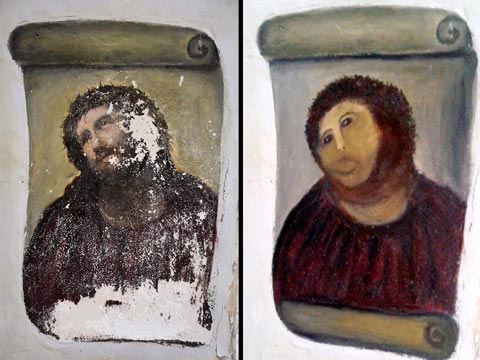
Consider another example: A woman in Spain took the art world by storm when she decided to save her church some time and money and restore her favorite piece of art. She went to work restoring the flaking, 100-year-olf fresco of Jesus, ecce homo, using skills that only the parent of a kindergartener could love. The result was a simian-looking Jesus that looked like a rhesus monkey with a lion’s mane and a robe. Just because someone's paid to restore works of art doesn't mean they can't mess it up — especially when seemingly minor mistakes can have major consequences.

Redos aren’t always as good. I get that sense from the reading from the prophet Isaiah. Isaiah 62 comes out of the post-exilic period, a period of new beginnings for the people of Israel, but also a period of unrealized hopes.  After generations in exile, the people of Israel have returned home and are rebuilding Jerusalem. They have high expectations, but things aren’t working out quite as expected.  The new Temple they are building lacks the grandeur of the old, destroyed one it is replacing. It’s lousy. And they feel lousy. Their new chance at self-determination is failing. The sequel isn’t so great.

And to make things worse, Isaiah uses the well-worn biblical image of a morally loose women to explain Israel’s feelings. The people of Israel are presented as a desperate, fallen harlot in need of deliverance by a man through marriage. Isaiah 62:1-5 is one of those texts that make progressive people cringe. In an age in which women have made tremendous strides in education, earnings and independence, this text sounds offensive to our modern ears.

At the same time, behind the offensive imagery we hear a grippingly tender voice. God is intimate and emotive. The people feel forsaken, despised and desolate. God feels differently. It’s as if God, the Beloved approaches her cherished darling from behind, wraps arms around her love and pulls her partner into a closer embrace. It is a scene of pure delight.

It reminds me of a scene from the book Mortal Lessons, in which physician Richard Selzer describes a meeting in a hospital room after performing surgery on a young woman's face: I stand by the bed where the young woman lies -- her face, postoperative -- her mouth twisted in palsy -- clownish. A tiny twig of the facial nerve, one of the muscles of her mouth, has been severed. She will be that way from now on. I had followed with religious fervor the curve of her flesh, I promise you that. Nevertheless, to remove the tumor in her cheek, I had cut this little nerve. Her young husband is in the room. He stands on the opposite side of the bed, and together they seem to be in a world all their own in the evening lamplight -- isolated from me -- private. Who are they? I ask myself -- he and this wry mouth I have made, who gaze at and touch each other so generously. The young woman speaks. “Will my mouth always be like this?” she asks. “Yes,” I say, “it will. It is because the nerve was cut.” “She nods and is silent. But the young man smiles. “I like it,” he says. “It’s kind of cute.” All at once I know who he is. I understand, and I lower my gaze. One is not bold in an encounter with the divine. Unmindful, he bends to kiss her crooked mouth, and I am so close I can see how he twists his own lips to accommodate to hers -- to show her that their kiss still works.

The God I encounter in this reading from Isaiah is the Partner who is willing to do whatever it takes to relish the transcendent beauty of the beloved.

I want you to think about the person sitting to your right and your left. Think about the person who is sitting in front of you and behind you. Think about your family and your friends. Think about the handful of people who drive you crazy. I’m going to tell you something about them. They know desolation. They know what it feels like to be God-forsaken. Let me tell you something else about them: Each and every one of those people, you and me included, aches to be loved. In a world that seems plagued by an epidemic of emotional agony, it’s not surprising that we are infatuated with love. Many people will go to great extremes to feel loved. Romantic fantasies . . . casual one-night-stands . . . we’ll spend billions of dollars on how-to-books, pills, make-up, and seductive clothes. But none of these seem to secure the kind of love that will fill the empty, lonely spot inside that waits for someone – anyone – to accept and passionately love the real me.

We all have times when we look inward, and see nothing but bare mountains, deserts, desolate wastes. We all have times when we feel alone; times when we feel distant from the people we adore.  We feel devastated when trusted friends betray us.  We are wounded when those whom we trust attack us for no legitimate reason.  We are confused when disease strikes us and those we love. We are perplexed when we cannot save ourselves and our loved ones from pain.

In his Spiritual Exercises, Ignatius of Loyola encourages a process of self -examination founded on the idea of listening for how our deepest feelings and yearnings can impact us.  He encourages us to get in touch with our areas of desolation. We don’t run from misery. We acknowledge the pain. And we also look for opportunities for consolation. Simply put: Consolation is whatever helps us connect with ourselves, others and God in life-giving ways.  Desolation is whatever disconnects us.

When I think of consolation, I think of a word I’ve introduced from this pulpit before. It’s from the Buddhist tradition. The word is Maitri -- Sanskrit for “unconditional friendship with one’s self.” Unconditional friendship with one’s self can be hard to find. We feel grief, shame, fear, anger and regret, and we look outside of ourselves for some validation.  A lot of this has to do with our relationship with pain and difficulty. What might happen if we stopped struggling against the pain in our life? This is not the kind of question we like to answer. We want a redo! We want a sequel. We want to fix pain, or at least ignore it. When we try to ignore pain, we ignore part of our very selves.

To this interior world of desolation, God speaks consolation. God says, “You are my delight.”  God takes great delight in raising people up from the dust. God finds those whom everyone else has given up on and uses them to radiates God’s glory to a broken world

This week, I want each of us to find a space where you can be alone with God. Sit quietly and allow the Sacred Spirit to confirm this message to you. Allow God to speak love to you in inward stillness. Come to God saying, “O God, lover of my body, mind and spirit, I am yours. I belong to you and you love me as I am.” And as you listen, may the Sacred Spirit twist and touch your pain you as you feel the kiss of a God who is totally in love with you

Friends, I have some good news for us today. In the words of poet Anne Weems:
In the godforsaken, obscene quicksand of life,
there is a deafening alleluia
rising from the souls of those who weep,
and of those who weep with those who weep.
If you watch, you will see
the hand of God
putting the stars back in their skies
one by one
Or, in the words of the Gospel According to Martina McBride, "God is great, but sometimes life ain't good/When I pray it doesn't always turn out like I think it should." 

God meets us in our desolation, and adorns us with garlands of beauty. Not only are we God’s delight, we can SHARE God’s delight in the most disappointing times, the most devastated places, in the deserts and wastelands and shadows. As Martina says:
You can spend your whole life building
Something from nothin'
One storm come and blow it all away.
Build it anyway.

You can chase a dream that seems so out of reach
And you know it might not ever come your way.
Dream it anyway.

This world's gone crazy and it's hard to believe
That tomorrow will be better than today.
Believe it anyway.

You can love someone with all your heart
For all the right reasons
In a moment they can choose to walk away.
Love 'em anyway.

You can pour your soul out singing a song you believe in
That tomorrow they'll forget you ever sang.
Sing it anyway.

God is great, but sometimes life ain't good.
When I pray it doesn't always turn out like I think it should.
But I do it anyway.
Life is tough. God is faithful. So sing, dream, love, pray, and wait, anyway. Why? Because you are God’s delight.

Sources:
Anyway, by Martina McBride, http://www.youtube.com/watch?v=6uLtyzRgmyI

Tuesday, January 15, 2013

Sermon for January 13, 2013 / Baptism of Christ

Called by Name
Everyone was expecting the Messiah to come soon, and they were eager to know whether John might be the Messiah. John answered their questions by saying, “I baptize you with water; but someone is coming soon who is greater than I am—so much greater that I’m not even worthy to be his slave and untie the straps of his sandals. He will baptize you with the Holy Spirit and with fire.  He is ready to separate the chaff from the wheat with his winnowing fork. Then he will clean up the threshing area, gathering the wheat into his barn but burning the chaff with never-ending fire . . .  One day when the crowds were being baptized, Jesus himself was baptized. As he was praying, the heavens opened, and the Holy Spirit, in bodily form, descended on him like a dove. And a voice from heaven said, “You are my dearly loved Son, and you bring me great joy. Luke 3:15-17, 21-22

People often ask me how I got into ministry. How did I know? The question usually comes from new encounters at dinner parties. When guests find out I’m a minister, they start trying to figure it out. It is a familiar but uncommon occupation, after all. You’d think I’d have a pat answer by now, but the question still makes me stumble. How did I know? Well . . . I just knew. I’ve known since I was 12 years old. Picture a serious, 12-year old boy who hears the voice of God and begins ordering the complete set of John Calvin’s commentaries on the Bible so that he can get an early start on his clerical studies; a boy staying up late and reading theology by flashlight long after his parents have told him to turn out the lights and go to sleep; a boy so caught up in the bliss of biblical studies, he cannot focus on world geography and mathematics. Got the picture? Well, that wasn’t me. I was a sassy, loud- mouthed 12-year-old who teased others relentlessly, watched Three’s Company and the Love Boat faithfully, listened to Toto sing Rosanna endlessly, and did not have much interest in reading anything. I was an average kid and an average student living in an average American household. That’s the kid God called into ministry. As I grew, I tried on different ideas for occupations.  By my college years, I talked myself into training to be a High School English teacher. But I could not shake the call to be a pastor.

I was ordained to ministry in 1997. It was a big worship service, concluding with me kneeling in front of the sanctuary as 15 or so ministers gathered around me. They were liberal and conservative; Black, White and Asian; male and female; younger and older. The ministers touched me head and shoulders, and prayed, and conferred the time-honored tradition of ordained ministry through the laying on of hands.

Do you remember the time you got ordained? You are, you know . . . Ordained! I’m not just talking to the 10-or 12 ordained ministers and seminary-trained folk who worship here at CCC each Sunday. I’m talking to all of us. You are a minister of the gospel. YOU are! And it happened at your baptism.

Through the course of time, baptism has lost some of its significance as the making of "ministers" in the world. Today we think of it as an initiation rite into the covenant life of church. This has led many to the unfortunate conclusion that pastors, those who are ordained, are the real ministers of the church and the laity are there just to undergird and support the work of the clergy.

Generally the notion of call is understood as a calling to professional ministry, with a seminary education and a path that leads to ordination. This has never been the only way to think about ministry in our congregational tradition. Some people are called to special functions in the church and are trained to fulfill those functions as ordained pastors and teachers. But our tradition teaches that God gives talents and abilities to all people, and calls all people to serve in many ways. We call it “the priesthood of all believers.” We believe that all of us who are on this journey of faith are ministers. We, in the United Church of Christ, believe that God calls each and every one of us. The call of God may be to a specific occupation, but most often it is to a task, a work, a mission, a ministry to others, which may have little to do with a  job. We have a name for the work of listening. We call it “discernment.” One of the jobs of the church member is to listen and reflect – to discern -- on life's journeys in ways that help us understand how God urges and prods us in a certain directions. There are moments when that process seems very clear and understandable, and there are times when it seems almost impossible to understand what God wants from us.

Today's gospel story recalls the baptism of Jesus. When Jesus is baptized, says Luke, a dove descends and a mysterious voice proclaims Jesus as a beloved child of God. Right after this event, Jesus begins his ministry of preaching, teaching, and healing -- a sign that the Reign of God is coming. Jesus' baptism is the day of his "ordination," the beginning point of his ministry. But Luke's gospel lets us know that the Holy Spirit has been working long before the day that Jesus is grown and beginning his ministry. Just a few weeks ago we heard the story of the angel's annunciation to Mary. Remember what the angel told Mary on that occasion? "The Holy Spirit will come upon you and the power of the Most High will overshadow you; therefore the child to be born will be holy; he will be called Son of God" (Luke 1:35). That day was the beginning of her work for God. It happens earlier in the Gospel to the parents of John the Baptist, too. In their old age, they will bring a child into the world who will be a prophet of hope.

In biblical times names had incredible importance. A name carried more than your identity. It said something about who you are, what your God is like, or how you were expected to live. As I read the beginning of Luke’s Gospel, I’m struck by the power of names. Maybe you remember these parts of the story: An angel appears to a priest named Zechariah and says, ““Do not be afraid, Zechariah . . . Your wife Elizabeth will bear you a son, and you are to call him John . . . And he will  . . . turn the hearts of the parents to their children and the disobedient to the wisdom of the righteous—to make ready a people prepared for the Lord.” The name John means, “God is Gracious” – a reminder of God’s loving presence. He will become known as John the Baptist. In the same way, an angel appears to Mary says, “You will conceive and give birth to a son, and you are to call him Jesus.  He will be great and will be called the Son of the Most High.” Luke even tells us about the naming ceremony in the Temple where Mary’s baby is named Jesus in fulfillment of the promise. The name Jesus means, “God saves.”

In today’s reading, with John and Jesus together, a voice from heaven speaks, directed at Jesus. “This is my son, my beloved.” I hear these words not as a description, but as a name. It’s as if the voice says, “Everyone look at this man. His name is God’s Beloved. I know him by name.” By the way, the word “beloved” in Hebrew might be related to the same word from which we get the name David. And we remember King David, the famous warlord of ancient Israel, is Jesus’ ancestor. Just as ancient kings like David were anointed with oil as a sign of their authority, Jesus, God’s Beloved and the new leader of God’s Reign, is anointed with the Spirit at his baptism. There is power in a name. And God knows it.

These traditions still carry over into today. We anoint with water. Some traditions use oil, too. Often we ask parents, “By what name will your child be known?” It’s our recognition that this little person will take on a special identity linked to a name. It’s also our way of remembering that God knows us. God forms us. God has meaning for our lives. God knows us by name.

And not just that, God CALLS us, God calls you, by name.

Maybe God is calling you to do something risky with your faith, but you ask “What’s going to happen to my future? Will this lead to grief, disappointment, or disaster? Will somebody bring violence or harm to me or my family? Will I suffer some disaster?”

Maybe you are being called to reconcile a bad relationship. We face the demands of relationships every day; loving those who are hard to love, forgiving the offender; making up with those whom we’ve wronged, living up to our vows, keeping our self‑promises, trying to be effective parents and partners.

Maybe you are being called out of our comfort zone, to stretch yourself, to travel new pathways and gain new experiences. As MLK Weekend approaches, think of the calling and struggles of Martin Luther King, Jr. In April of 1963, Martin was arrested and placed in jail in Birmingham, Alabama for his non-violent resistance to segregation. After King’s incarceration, eight leading Christian and Jewish religious leaders in that city released a statement criticizing Martin’s work and ideas, saying that his activities to end segregation in the South were, “unwise and untimely.” In response to that statement, Martin wrote these eight men, what has come to be known as his Letter from Birmingham Jail. Martin wrote: “I am in Birmingham because injustice is here. . . injustice anywhere is a threat to justice everywhere.. . Just as the prophets carried ‘thus saith the Lord’ far beyond their villages, and just like the apostle Paul carried the gospel of Jesus Christ to the far corners of the Greco-Roman world, so am I compelled to carry the gospel of freedom. . . we must see the need for nonviolent gadflies to create the kind of tension in society that will help men rise from the depths of prejudice and racism to the majestic heights of understanding and brotherhood.”

Martin struggled to rise above that deadening culture where people did only what was right in their own eyes. He chose not give in. He chose not to serve the immoral culture and to become separated from God in the process. He chose to follow God’s ways of justice, freedom and love. He chose to move out of the dead zone of racial hatred where God’s call could not be heard, to the life giving zone of justice and love

Today, we must hear and heed our own call, as individuals and as a community of faith.
Listen because God calls us by name. It might be through a still, small voice. You may hear it in the turmoil of daily events. To hear it is always a moment of grace. You have gifts that God has given you. God wants you to use them. There are needs in this Church where God may be inviting you to use your gifts and abilities to make a difference. God calls us to evaluate our commitment to justice, freedom and love. God knows you, and God knows us. God has a calling for you whether you realize it or not. And God is calling for us. 

To be honest, I have already seen you in ministry, CCC. I have evidence that you are ordained -- gifted with the Divine Spirit for ministry. I have seen you at ministry in the choir room, or a Sunday school room, or the sick room, or the meeting room. I've seen you ministering to the homeless and to the hungry. I have seen you minister to one another in times of sickness and tragedy. Many have expressed their desire to help. You want to minister.

So in a way, I said it wrong. The day I got ordained was not that afternoon back in 1997 when a group of ministers laid hands on my head. The day I got ordained as a minister was a Sunday morning all the way back in 1978 when a UCC pastor dipped his hand in a baptismal bowl, poured water on my 8-year-old head, reminded by family and me that I had been given the Holy Spirit, and made me a minister.

One reason why we are here in church on Sunday is to be fed, to be nourished, for ministry. As one of your pastors, I preach and I teach and in order that you might preach and teach wherever you go in the coming week. I help serve the sacraments so that you might be the sacramental presence of God wherever you go.

So go and be a minister! Let us use the gifts God has given us as a sign of the outbreak of the presence of God. Let us be the ministers that God has called us, ordained us, to be.

Sermon for October 6, 2019

Abundant Bread Preached by Pastor Matt Braddock They found him on the other side of the lake and asked, “Rabbi, when did you get her...